Software compliance sounds like an audit problem, but day to day it is two simple questions. Do we have enough seats for the people using the software? And are we paying for seats nobody uses? Answer both regularly and the rest follows.
Why this matters
Software is usually the second largest IT cost after hardware, and the one that is tracked worst. Over-buying quietly wastes money. Under-buying creates risk, because vendors can audit you and ask for back payments. Both come from the same cause: nobody can say, on a given day, how many seats exist and how many are in use.
Count seats, not licenses
A seat is one permitted use of a license. A purchase of fifty seats is one record with fifty slots. Compliance means knowing how many slots are filled, by whom, and how many are free. A spreadsheet row that says "50" tells you nothing about the third question.
- Record the number of seats bought, the purchase date and the expiry date.
- Assign each seat to a person or a device.
- Keep the license key or the purchase reference with the record, not in someone's inbox.
Know your license types
Not every license counts the same way, and compliance starts with knowing which kind you hold. Named-user licenses belong to one person. Concurrent licenses allow a fixed number of people at the same time. Device licenses attach to a machine, and subscription licenses run for a period and then expire. Read the terms of your most expensive products and write the counting rule next to each record, so whoever reviews it later does not have to guess.
Renewals do not announce themselves
Subscriptions renew, or lapse, on a date somebody agreed to once. If nobody is looking at that date, you either auto-renew a seat count that is too high or discover the lapse when work stops. Put every expiry in one place, and look at it ahead of time.
A useful rule is to review each renewal a month before the date, with the actual usage in front of you. That is when you can still change the number.
Reclaim before you buy
The cheapest license is the one you already own. When people leave or change role, their seats should return to the pool rather than sit idle until the next true-up. Licenses marked reassignable can be handed straight to the next person.
The cheapest license is the one you already own.
Shadow IT and free trials
Not all software is bought through procurement. A team signs up for a tool with a company card, a free trial converts into a paid plan, or a plugin is installed on a few machines. These are the licenses that surprise you at an audit. Ask finance for a list of recurring software charges once a quarter and compare it with your register. Every line that has no matching record is either a missing license or a subscription to cancel.
Prepare for a vendor audit
When a vendor asks you to prove your usage, calm preparation makes all the difference. You want to be able to show, for each product, the entitlement you hold, the proof of purchase, and the people or devices using it. If your register already holds these, an audit is an afternoon of exporting records. If it does not, it becomes a scramble that rarely ends in your favour.
- Keep purchase references and invoices linked to each license.
- Record the version and edition where the terms differ.
- Keep the history of who held each seat and when it moved.
A quarterly routine
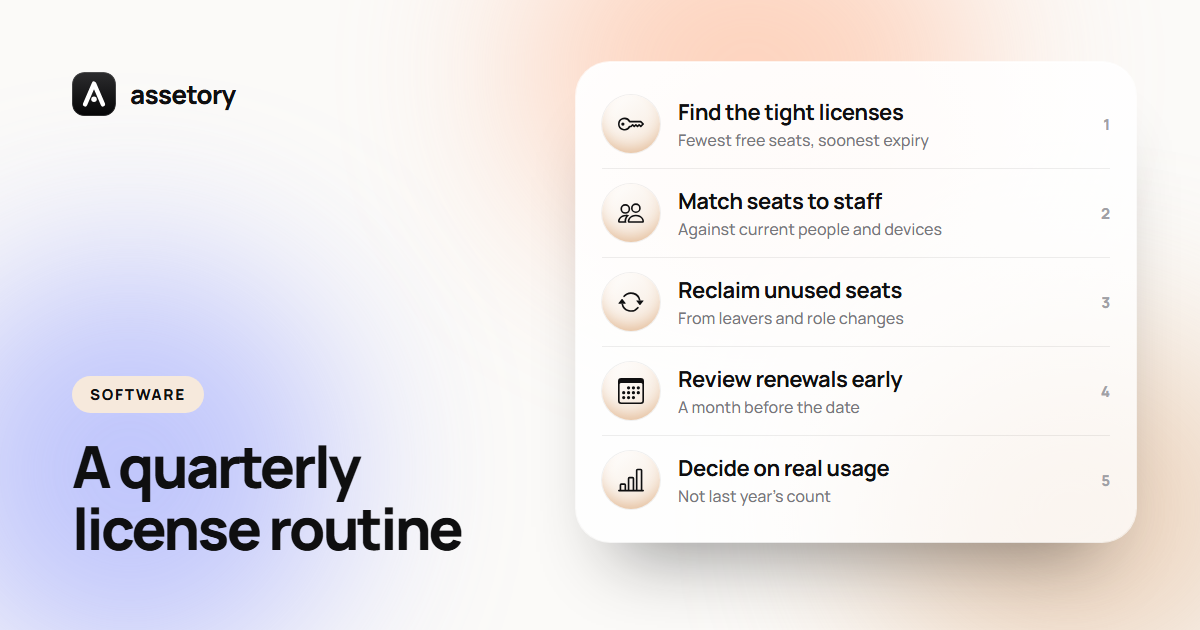
- List licenses with the fewest free seats and the soonest expiry.
- Check each assigned seat against current staff and devices.
- Reclaim seats from leavers and from people who no longer need the tool.
- Decide renewals with the real number of users, not last year's count.
Half an hour each quarter is usually enough to stay both compliant and lean.
Common questions about software license compliance
What is the difference between a license and a seat?
The license is the agreement and the purchase. A seat is one unit of use under it. One license can hold many seats, and tracking at the seat level is what tells you whether you are compliant.
What happens if we are under-licensed?
Vendors can ask you to buy the missing seats, often at list price, and may add back-dated fees. Finding the gap yourself, and fixing it at your next renewal, is nearly always cheaper than having it found for you.
How do we handle software that people install on their own?
Set a simple rule for requests, make the approved route quick, and review recurring charges every quarter. People install their own tools mainly when the official route is slow. A fast approval process brings most of that software back into the register.
Do open-source tools need tracking too?
Usually there is no seat to count, but the terms still matter, especially for commercial use or distribution. Keep a short list of what you use, the version, and the license type, so a review does not start from nothing.
Who should own license management?
Give it a named owner, usually in IT or procurement. Finance should receive the renewal calendar, and each department should confirm its usage once a quarter. Shared ownership with a clear lead keeps the records accurate without becoming one person's full-time job.
How long should we keep license records?
Keep proof of purchase and the history of assignments for at least as long as the license is active, plus the period your finance team requires for tax and audit. Old records are cheap to store and expensive to recreate when a vendor asks for them.
Can we move seats between people?
That depends on the terms. Some licenses allow reassignment freely, others tie a seat to a named user for a period. Record the rule on the license itself, so the person handling a leaver knows straight away whether the seat can be handed to someone else.
What is the first step if we have no records at all?
Start with the three or four products that cost the most, since they carry most of the risk and most of the savings. List what you own from invoices and vendor portals, count the people using each product, and compare the two numbers. You will learn more from that single exercise than from a perfect inventory started a year from now.
Want to see this in practice? Explore Software licenses in Assetory, or book a demo.